
We’re back with another ASCF investor’s update, analysing all the key economic and market trends from the past month, from RBA prospects, to the property market, to inflation, and beyond.
You can catch up with past investor’s updates on the ASCF Blog. If you would like to receive these updates monthly via email, you can sign up to receive an Investor Pack here. To learn more, see our page on How to Invest.
Trading Update
Following their August meeting, the RBA left the official cash rate at 4.35%. The decision was unanimous, with the Board noting that “the economy appears to be slowing as expected. But inflation is still too high.” The RBA are next set to meet on September 29th.
RBA Prospects
Following this news, the Big Four banks all now forecast that the RBA will remain on hold for the rest of 2026. However, Westpac, CommBank, and ANZ still acknowledge the possibility of a further hike in November. Westpac notes “while we believe that investors should allow for some risk of a hike later this year, it is not our base case.”
Looking further ahead, CommBank now forecasts eventual rate cuts to arrive in May and August of 2027. ANZ sees things similarly, also forecasting two cuts in the second half of 2027.
Westpac expects cuts to eventually come in 2027 too, but not until August, while NAB have taken the most dovish long-term view, predicting three rate cuts in 2027 beginning in Q2.
Inflation, Employment, & Property Market
The CPI rose to 3.8% in the 12 months to June 2026, down from 4.0% in the 12 months to May 2026, while in seasonally adjusted terms, the CPI fell by 0.1% in June.
Trimmed mean inflation remained at 3.6% in June, unchanged from 3.6% in the 12 months to May 2026. This was lower than the RBA previously forecasted, but still well above the 2-3% target range. The largest contributor to this change was transport costs, which fell by -2.6% MoM in seasonally adjusted terms.
Unemployment rose to 4.5% in July, up from 4.4% in June, with the number of unemployed people rising by 0.6% MoM in seasonally adjusted terms.
In the property market, Australian dwelling values continued to go backwards in July, posting a -0.7% monthly decline, which marks the largest single-month decline in Australian property values since December 2022.
While the decline in property prices has continued, we expect it to level off over the coming 2-3 months—our internal view is that we are probably halfway there. With the RBA now most likely on hold for the remainder of the year and rate cuts forecast for 2027, we expect some level of confidence to return to the market. Unfortunately, we do expect rents to continue increasing, as we do not see any sort of meaningful policy response addressing the structural undersupply of housing from the government at any level.
How ASCF Helps
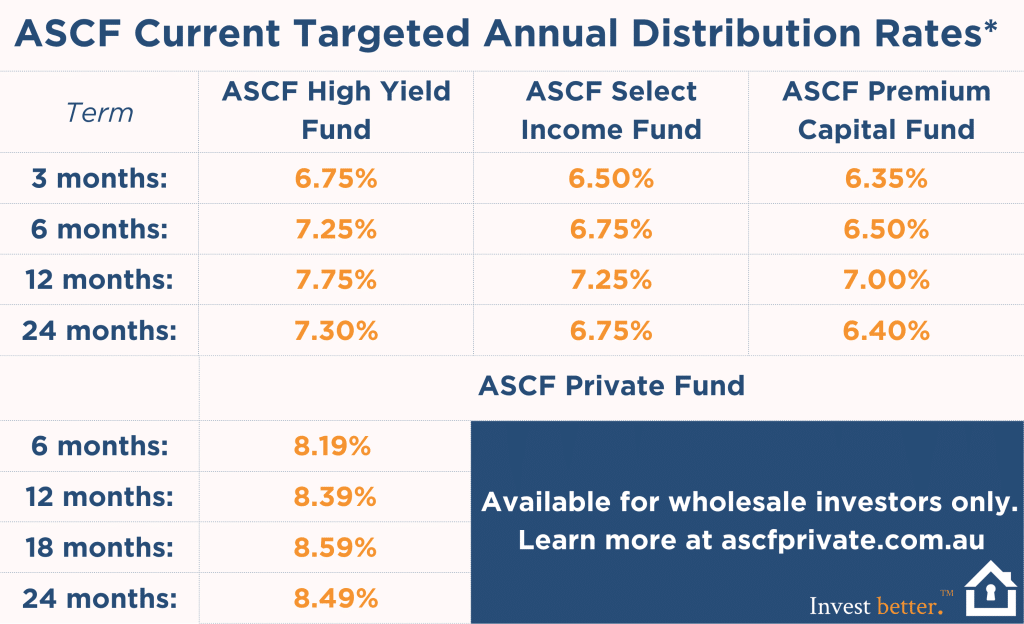
Despite shifting RBA forecasts and “still too high” inflation, ASCF’s funds provide an appealing alternative to fluctuating variable-rate assets. Our ASCF High Yield Fund offers a targeted distribution rate of 7.75% per annum for a 12-month fixed term, with interest paid monthly, and is worth considering as part of any diversified investment portfolio.*
Interested in investing in ASCF or increasing your investment in the funds? Book a time to receive a call back at your convenience.
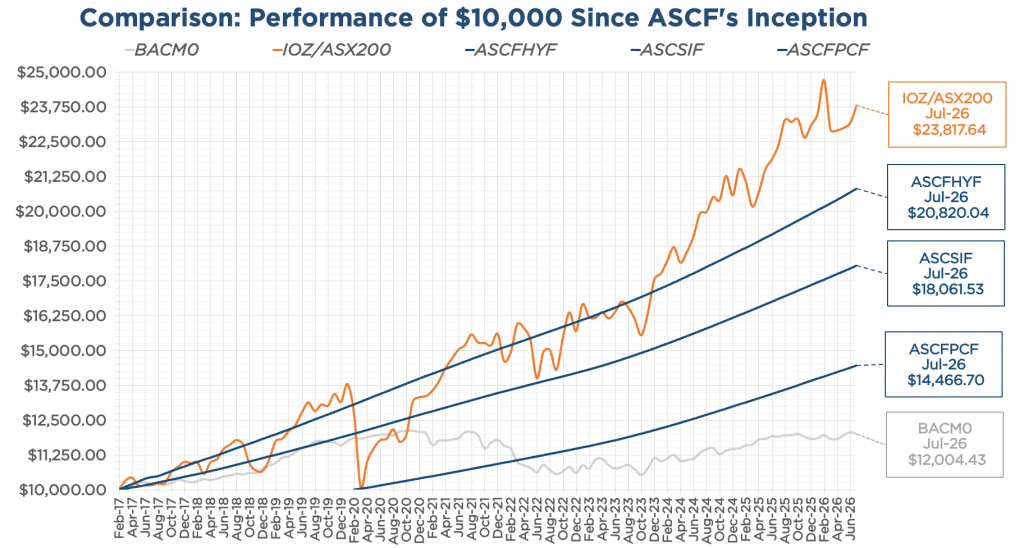
Sources: Australian Fund Monitors, Bloomberg, Investing.com
Note 1: Premium Capital Fund began in February of 2020
Note 2: Past performance is not indicative of future performance.
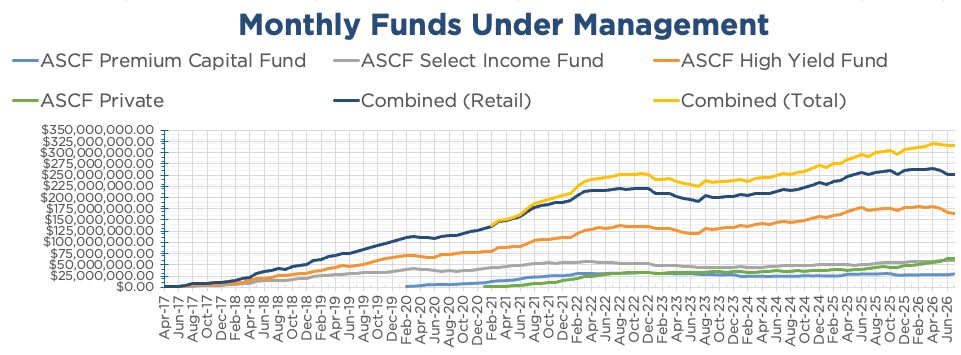
-4.png?width=1200&upscale=true&name=Newsletter%20Stats%20Graphics%202026%20(1)-4.png)
To learn more, see our Investor FAQs.
Lending Activity Update
In July, inquiry levels were strong, with $16,101,847.87 in loans settled.
The unit price across all three of our retail funds remains at $1.00 per unit, and all monthly distributions have been paid in full for July.
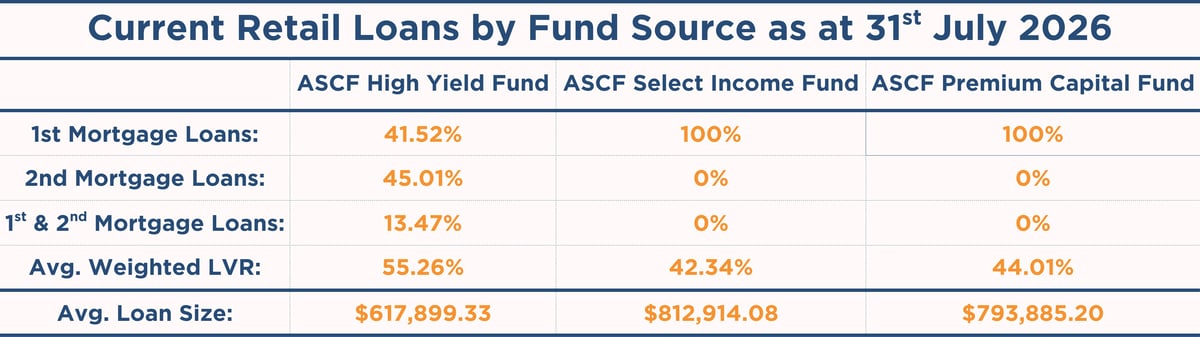
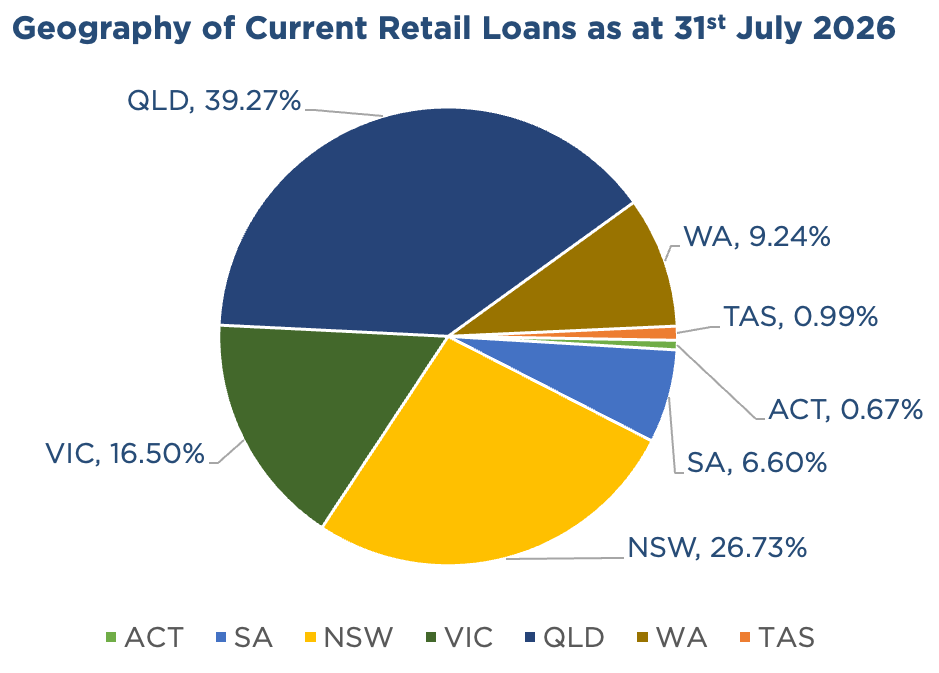
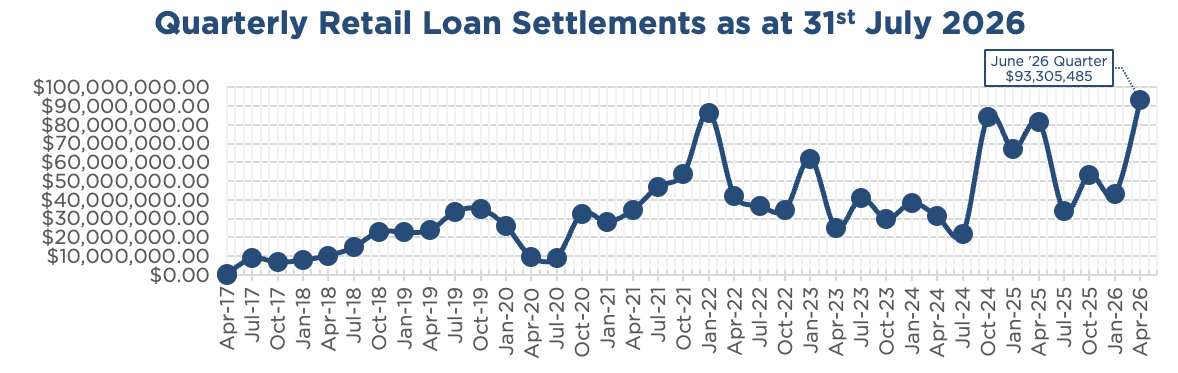
To learn more, see our Borrower FAQs or visit our Loan Summary as at 31st July 2026.
Sometimes, Boring Is a Good Investment
Investing is often made to sound complicated.
Shares, property prices, interest rates, economic forecasts—there is always something to consider. However, for many investors, particularly those approaching retirement, perhaps one of the most valuable qualities in a potential investment is predictability.
This is where private lending can be worth consideration. Private pooled mortgage funds provide investors with exposure to a portfolio of loans secured against property. This means that rather than relying on share prices rising or property values increasing, the investment is based on borrowers paying interest on their loans, with the added peace of mind that the loan is secured by a mortgage over their property.
Given this, one of the most common questions we get isn’t simply: “What rate of return will I receive?” but also: “How is the associated risk being managed?” That involves things like evaluating the quality of the underlying property security, LVRs, borrower assessment, diversification, loan monitoring, the experience of the fund manager, and more.
Of course, private mortgage funds aren’t designed to replace every other investment. However, they can provide another asset class for investors looking for an income-producing component within a diversified portfolio.
There are no guarantees with any investment, and private lending carries its own risks. But for investors who value a clearly defined strategy, property-backed lending, and a focus on income, it can be a worthwhile option to consider.
Investing doesn’t always have to be exciting. But, at ASCF, with all historical distributions paid on time and in full and all withdrawal requests met in accordance with our fund terms, sometimes, boring is just what we want!
Want to learn more? Contact us to explore your investment options.
Important information: Since inception, all investors have received their targeted distribution rate monthly, and all redemption requests have been paid on time and in full. However, past performance is not indicative of future performance. Distributions are not guaranteed, nor a forecast. Lower than expected returns may be achieved. Investment in the Funds is not a bank deposit, and investors risk losing some or all of their capital. Read the PDS and TMD, available from our website.
An Interesting Transaction
Problem:
A broker approached ASCF seeking funding for an incomplete residential construction in Newport, QLD after being unable to source a solution through their standard lender panel. The borrower had successfully self-funded the project up to the frame stage of construction, but required an additional $300,000 to complete the build.
Solution:
ASCF engaged a panel valuer to provide a land-only valuation. Based on this assessment, ASCF provided a $620,000 1st mortgage loan over a 6-month term at 10.95% p.a, representing an LVR of 59.05% against the land value alone. The initial drawdown of $411,000 has been completed, with the additional funding to be drawn as required.
This 6-month term was structured to provide the borrower with sufficient runway to complete construction and give the borrower time to refinance upon completion.
The ASCF Advantage:
At a time of escalating building costs and construction delays, many customers are finding it difficult to access the funding to complete construction projects. At ASCF, we understand that sometimes customers have lending requirements that do not fit traditional lenders and can often structure practical funding solutions for borrowers.
Property Update
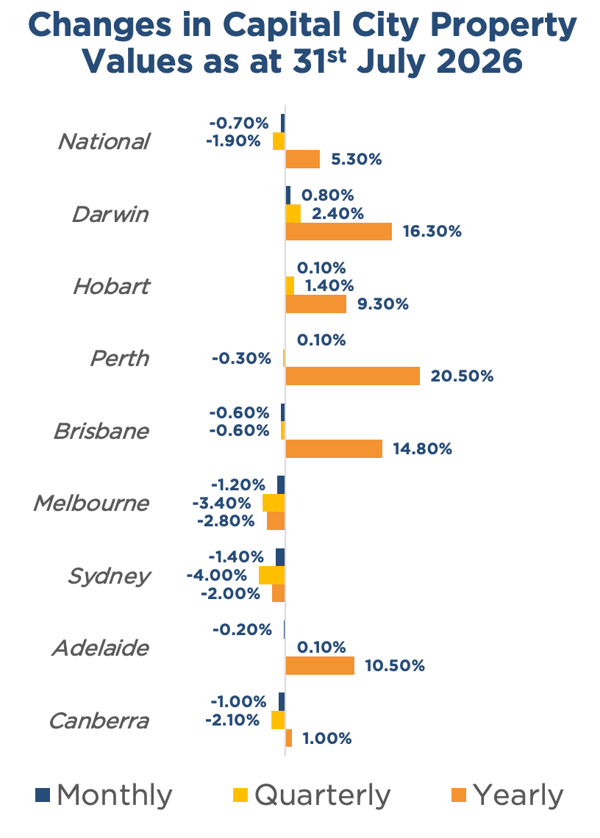
July continued the recent trend of declining Australian property values with a -0.7% monthly decrease. This marks the third consecutive monthly decline, and the largest single-month decline in Australian property values since December 2022.
Sydney (-1.4%) and Melbourne (-1.2%) still lead the way in this regard, posting their sixth consecutive monthly declines.
Even the mid-sized capitals of Perth (-0.3%), Adelaide (-0.2%), and Brisbane (-0.6%), which had previously been resilient in the face of this decline, have now joined the slide. In contrast, Darwin (+0.8%) and Hobart (+0.1%) still managed to post slight monthly gains.
Capital city auction clearance rates have rebounded somewhat to post an 11-week high of 55.1% for the week ending August 9th, having fallen to a low of 47.4% for the week ending June 21st. However, this remains well below the decade’s average preliminary clearance rate of 68%.
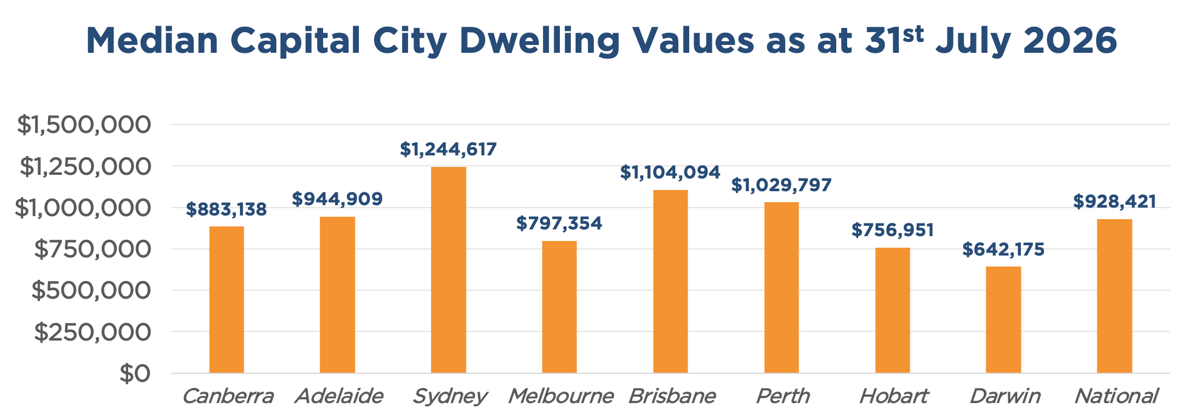
Source: Cotality HVI, 03 August 2026
Are you looking to invest in ASCF or increase your investment in the funds? Book a time to receive a call back at your convenience.